plasticker-News
Anzeige

| 2026-10-12, 06:00 |

|
Wittmann combines PCR processing, foam injection molding and inline quality control
  At the heart of the cell is a servohydraulic SmartPower injection molding machine with a clamping force of 300 tonnes. The machine processes a recycled polypropylene supplied by Borouge in a mold from Schicktanz. According to Wittmann, the polymer feedstock is derived from post-consumer collection streams. To reduce both material consumption and component weight, the application uses Wittmann’s Cellmould physical foam injection molding technology. Advert During the Cellmould process, nitrogen is introduced into the polymer melt during plasticizing. As the melt is injected into the mold cavity, the gas expands and forms a microcellular foam structure within the molded part. This reduces material usage and part weight while also enabling the process to run at lower injection pressures and with reduced clamping force compared with conventional compact injection molding.
The resulting reduction in processing forces can also lower energy consumption. In addition, the expanding gas helps fill geometrically challenging areas of the molded part, including thin-wall sections and undercuts. According to Wittmann, Cellmould is also suitable for the stable processing of recycled materials. Dimensional accuracy is a key requirement in the Fakuma application because the molded plant containers are designed to be stacked as part of vertical gardening systems. Geometrical deviations could impair their stacking function and increase reject rates. Wittmann has developed its own plasticizing unit for the physical foaming process. The patented three-zone Cellmould screw is manufactured in-house and is designed for use with a range of polymer materials. Its three screw sections can be replaced independently, which is intended to simplify maintenance. The foaming process is controlled through the machine’s B8X control system. 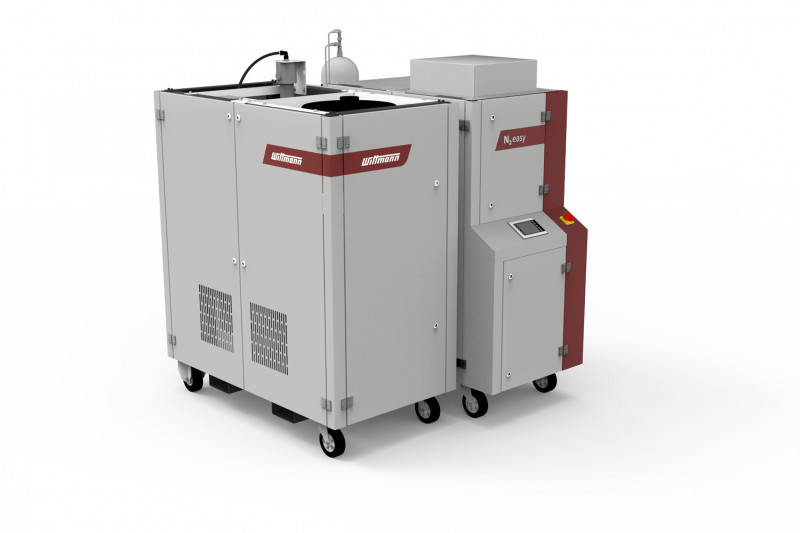 After demolding by a WX142 linear robot, every plant container undergoes automated inline thermographic inspection. An infrared camera mounted on the robot captures a thermal image of each molded part. The inspection software compares the recorded image with a stored reference, and parts that fall outside defined tolerance limits are automatically rejected. The thermographic data can provide information on both surface homogeneity and internal part structures, allowing the system to monitor not only the finished component but also the consistency of the foaming process. The robot, conveyor and safety enclosure are integrated into Wittmann’s FlexCell primus automation cell, which docks directly onto the injection molding machine. In the configuration shown at Fakuma, the safety enclosure is mounted on the conveyor, eliminating the need for additional floor space. The complete cell can also be moved sideways to provide access to the mold area. According to Wittmann, the modular automation concept can be combined with injection molding machines from different manufacturers and is suitable for retrofitting into existing production environments. The Fakuma application brings together several technologies currently shaping plastics processing: the use of post-consumer recyclates, physical foaming to reduce material consumption and component weight, energy-efficient machine technology, decentralized nitrogen generation and automated inline quality control. Rather than focusing on a single process innovation, Wittmann is presenting the cell as an example of how these technologies can be integrated into a compact, automated production system. Fakuma 2026 Friedrichshafen, Germany October 12–16, 2026 Hall B1, Booth 1204 More information: www.wittmann-group.com |
Wittmann Tec Group GmbH, Vienna, Austria + Wittmann Battenfeld GmbH, Kottingbrunn, Austria + Wittmann Technology GmbH, Vienna, Austria + Wittmann Battenfeld Deutschland GmbH, Meinerzhagen, Germany
 back to news list | back to top |
Anzeige