plasticker-News
Anzeige
| 2026-09-21, 06:00 |

|
Lehvoss Highlights Cost-Saving Potential of Compounds and Masterbatches
 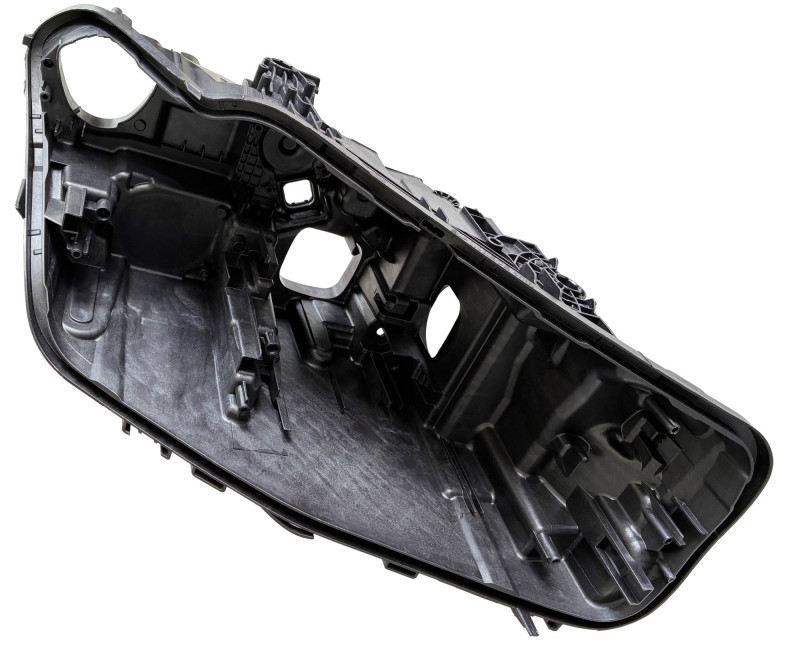 Headlamp housing – Lower weight and higher productivity with “Luvobatch” blowing-agent masterbatches - (Photo: Lehvoss). The examples span agricultural technology, automotive applications, lighting and ergonomics. In addition to material savings, they address factors such as component weight, cycle time, energy consumption and maintenance requirements. For an autonomous agricultural drone, Lehvoss uses carbon-fiber-reinforced compounds based on its “Xcf technology” for the rotor blades. Compared with conventional carbon-fiber compounds, the company reports stiffness increases of up to 48 percent. The materials are said to achieve flexural strengths of up to 520 MPa, tensile moduli of up to 52 GPa and tensile strengths of up to 425 MPa. Advert The higher rotor-blade stiffness is designed to reduce deformation under load and, in turn, lower energy consumption. The application uses high-performance compounds from the “Luvocom” portfolio.
A second exhibit is a headlamp housing produced with blowing-agent masterbatches to reduce weight and improve process efficiency. According to Lehvoss, in-mold foaming can lower the weight of large injection-molded components by up to 25 percent while maintaining the required impact resistance and dimensional stability. For the component on display, the company reports a 21 percent shorter cycle time and a volume-based material cost reduction of up to 15 percent. Lehvoss adds that the process can be implemented without additional investment in machinery. The application uses “Luvobatch” blowing-agent masterbatches. In a work light, Lehvoss has replaced a die-cast aluminum housing with an injection-molded housing made from a thermally conductive polymer. This eliminates deburring and painting, as the required color can be incorporated directly into the material. The “Luvotech eco TC” compound used in the application offers thermal conductivity of up to 18 W/mK, according to Lehvoss. Compared with the die-cast aluminum version, the polymer housing is said to be 36 percent lighter while reducing component costs by up to 14 percent. The company also reports CO2 emission savings of up to 60 percent compared with virgin material. The fourth application is an exoskeleton in which three metal parts have been replaced by polymer-based solutions. Structural members and gearbox housings are made from reinforced metal-replacement compounds, while a tribologically modified material is used for a drive gear. Lehvoss says the material substitution reduces weight by up to 1.3 kilograms and can extend battery runtime by up to 19 percent. The gearbox is also designed for maintenance-free operation. The application uses structural and tribologically modified compounds from the “Luvocom” range. Across all four examples, Lehvoss combines material substitution and process optimization with measurable economic benefits. The applications demonstrate gains ranging from higher component stiffness and shorter injection-molding cycles to lower weight and the replacement of metal parts with engineering plastics. Fakuma 2026 Friedrichshafen, Germany October 12–16, 2026 Hall B1, Booth 1109 More information: www.lehvoss.de |
Lehmann&Voss&Co. KG, Hamburg, Germany
 back to news list back to news list | back to top |
Anzeige