plasticker-News
Anzeige
| 2026-10-09, 06:00 |

|
IKT Showcases Research in Joining Technology, Recycling and Sustainable Plastics
 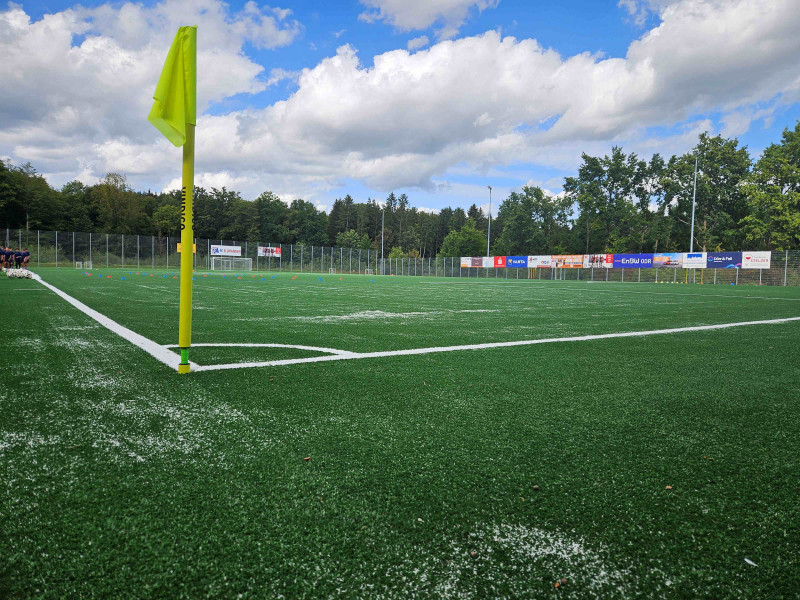 Bio-based synthetic turf pitch in Ellwangen, Germany – (Photo: IKT). Additive friction stir welding for thermoplastics In additive friction stir welding, filler material is fed directly into the process zone. This allows weld gaps to be bridged while also enabling targeted modification of the properties within the joining zone. The approach is particularly promising for fibre-reinforced thermoplastics, as reinforcing fibres can be transported across the joining interface, helping to reduce the loss of mechanical strength typically associated with welded joints. Advert 
Together with other institutes at the University of Stuttgart, IKT is further developing the process for future industrial applications. A modular tooling concept is intended to make friction stir welding heads available as add-on units for existing CNC machines and robotic systems. The technology is therefore suitable not only for joining thermoplastic materials, but also for additive manufacturing applications. Synthetic turf made from bio-based and recycled materials Another focus is a sustainable synthetic turf system developed and investigated as part of the collaborative “NaKuRa” research project. IKT’s work focuses on the material behaviour of the plastic components used in the system. The concept makes use of bio-based or recycled plastics, while a biodegradable material is used as infill between the turf fibres. One of the main objectives is to reduce the release of microplastics from synthetic turf systems. Mechanical recycling of polyurethane through reactive extrusion In polyurethane recycling, IKT is investigating an approach in which used polyurethane foam is incorporated as a filler into newly produced foam. Instead of conventional mixing heads, the reactants and recycled material are processed in a twin-screw extruder. According to the institute, conventional mixing systems generally allow foam recyclates to be incorporated at levels of less than five percent by weight. The extrusion-based approach, by contrast, is aimed at achieving filler contents of more than 75 percent by weight. IKT reports that the basic feasibility of the process has already been demonstrated on a laboratory scale. Key challenges in transferring the technology to a continuous process include reproducible dosing, sufficient mixing quality, reliable sealing of the extruder, as well as the management of high rotational speeds and effective cooling. One of the target applications is the production of insulation panels for buildings. The institute is therefore investigating how different proportions of recycled material affect both processing behaviour and the resulting material properties. With these exhibits, IKT brings together research in joining technology, circular plastics and application-oriented materials development at Fakuma 2026. Fakuma 2026, Friedrichshafen, 12–16 October 2026, Hall A7, Stand 7102 More information: www.ikt.uni-stuttgart.de, www.uni-stuttgart.de |
University Stuttgart, Institute of Plastics Technology (IKT), Stuttgart, Germany
 back to news list back to news list | back to top |
Anzeige