| 2009-04-08 |
|
|
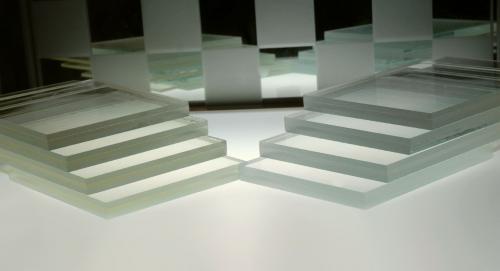
Laminated architectural glass is being used increasingly to meet modern safety codes and save energy through added daylighting and solar design. It also adds anti-intrusion security, sound reduction and protection from UV rays. Two common types of interlayer for laminated glass are films made of polyvinyl butyral, also called PVB, or DuPont™ SentryGlas® ionoplast (www.safetyglass.dupont.com). The latter, developed especially for structural elements in architectural glazing, offers greater levels of clarity, is 5 times tougher and up to 100 times stiffer than PVB. Accordingly, SentryGlas® is particularly well-suited to overhead glazing installations, facades, stair treads, balustrades or flooring applications. The laminates photographed here were made with low-iron glass, gaining popularity for its clear white light, compared to using normal (greenish) glass. In laminates made with low-iron glass, the color contributed by the interlayer becomes more important. Many architects prefer the more natural, non-yellow light transmitted through low-iron laminates made with SentryGlas® interlayers (Photo, right) over those made with PVB (Photo, left). |
DuPont de Nemours (Deutschland) GmbH, Neu-Isenburg, Germany
GASPO Living GmbH
4694 Ohlsdorf, Austria
Eu-Rec GmbH
54411 Hermeskeil, Germany
Grünstoff Polymer Recycling GmbH
63820 Elsenfeld, Germany
SV Büro HvS-Havariekommissariat von Scherer
90522 Oberasbach, Germany
Plastium GmbH
78730 Lauterbach, Germany