plasticker-News
Anzeige
| 2026-09-24, 06:00 |

|
Pröll: New Screen Printing Inks and Protective Coatings for IMD/FIM and Functional Plastic Surfaces
 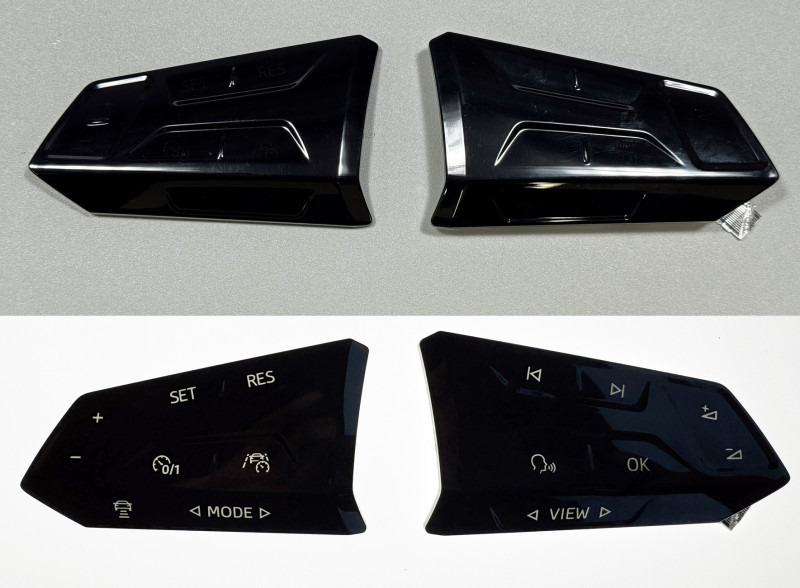 Steering wheel switch – Functional IMD/FIM component from KH-Helmbrechts featuring a disappearing-effect design. Non-conductive IMD/FIM ink systems are used in combination with a sensor film. Top row: reflected light; bottom row: backlit - (Photo: Pröll). For printed electronics applications, Pröll has developed “Noriphan HTR N 990/011 NC,” a carbon-black-free, non-conductive black ink within its solvent-based, one-component “Noriphan HTR N” screen printing ink system. The system is formable and designed for direct film insert molding. The new grade offers an opaque, deep-black appearance, high optical density and electrical resistance in the gigaohm range, while remaining transparent to radar waves. Advert “Noriphan HTR N 990/011 NC” can be used both for decorative purposes and as a multilayer base for metallic or polymer conductor pastes. By eliminating carbon-based black pigments, Pröll aims to prevent interactions with printed electronic structures. According to the company, the system meets elevated requirements for thermal and hydrolysis resistance in automotive applications. Interlayer adhesion within the film, ink and injection-molded substrate composite has also been optimized.
With “Noriphan HTR N 959,” Pröll is adding another carbon-black-free, non-conductive black screen printing ink to its portfolio. The ink appears black in reflected light but transparent violet in transmitted light. It is therefore suitable for black-panel applications and for areas that need to remain transparent to radar, infrared or lidar radiation. Typical applications include functional display and control surfaces in vehicles. The new “Noriphan HTR N 093/800” light-diffusing coating is also part of the one-component IMD/FIM system and can be directly back-molded after printing. The white-translucent coating produces a diffuse appearance on films while combining high light scattering with high transmission. It is designed to homogenize point light sources, for example in backlit controls or large-area ambient-lighting applications in vehicle interiors. The coating can therefore replace functions previously performed by separate light-management films. 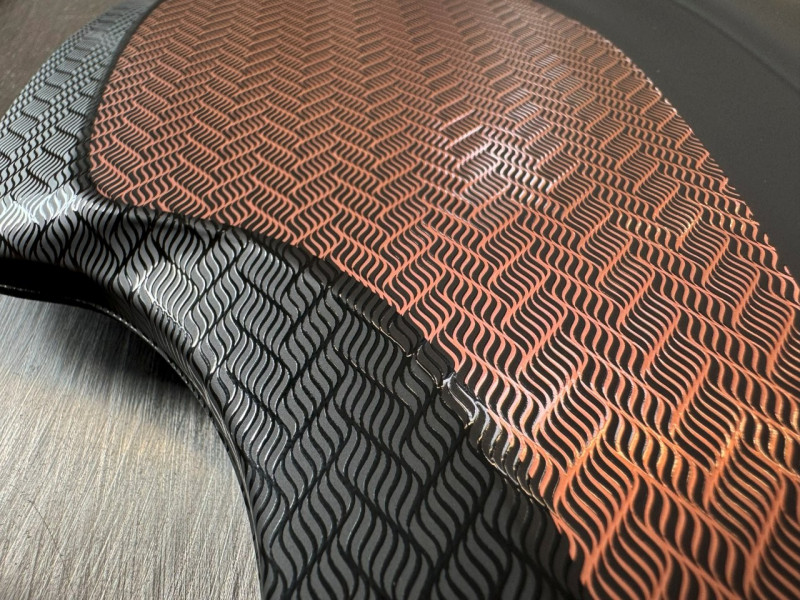 Tactile, durable coating structures printed on the front side using the “Norilux FastCure 1” surface-protection coating. The reverse-side decoration was printed using the “Noriphan HTR N” IMD/FIM ink system - (Photo: Pröll). “Norilux FastCure 1” is available in a high-gloss version, “FastCure 1/001,” and a matte version, “FastCure 1/002.” This makes it possible to create different gloss levels and functional display windows on a single component. Tactile structures, including brushed effects and three-dimensional patterns, can also be printed. Once cured, the coating is designed to provide high resistance to abrasion, chemicals and cleaning agents. Pröll cites automotive center stacks, control panels and decorative trim as key applications, alongside housings and bezels used in electronics and sanitary products. With “NoriCure ORL-1,” Pröll is expanding its portfolio with a UV-curing, weather-resistant screen printing coating designed to protect underlying ink layers and substrates against UV radiation. The coating is suitable for selected solvent-based ink systems as well as self-adhesive PVC films, polycarbonate, rigid PVC and PMMA. It is available as the high-gloss “NoriCure ORL-1/001” and matte “NoriCure ORL-1/002” versions. According to Pröll, the system is designed for high processing speeds and offers strong resistance to scratching, abrasion and chemicals. “NoriCure HC-1” is another UV-curing protective coating developed for display windows and scales. The high-gloss coating can be applied to PC films, coated PET films and PVC films, among other substrates, and can also be printed over UV-curing, solvent-based and water-based screen printing inks as well as offset inks. In addition to the standard version, matte, textured and UV-stabilized variants are planned. Once cured, the coating is designed to provide high scratch, abrasion and chemical resistance. Pröll is also targeting shorter drying times with its “NoriPUR” screen printing ink system. Designed for use as either a one- or two-component system, NoriPUR adheres to a wide range of plastics and metals, including rigid PVC, pretreated polyester and polyolefin substrates, acrylic glass and polycarbonate. When used as a two-component system, conventional hardeners can be replaced by NIR-activatable Hardener 047. The hardener is optimized for near-infrared drying and significantly accelerates curing of the printed ink layers. 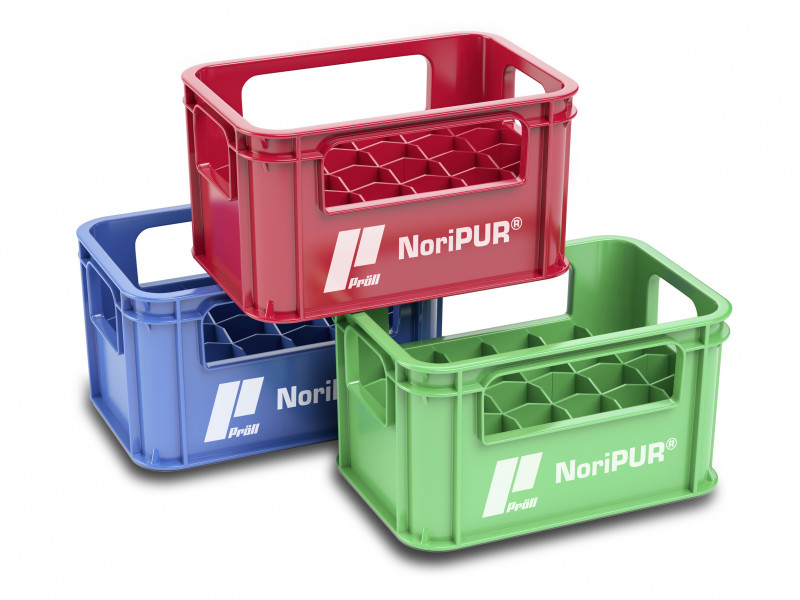 “NoriPUR” – Beverage crates screen printed with highly opaque color shades - (Photo: Pröll). Overall, the new products reflect Pröll’s increasing focus on functional printed and coated layers for plastic components. Key development areas include the combination of decorative, electrical and optical functions, integration into IMD/FIM manufacturing processes and reduced curing and processing times. Fakuma 2026 Friedrichshafen, Germany October 12–16, 2026 Hall A4, Booth 4120 More information: www.proell.de |
Pröll GmbH, Weißenburg, Germany
 back to news list back to news list | back to top |
Anzeige