plasticker-News
Anzeige

| 2026-01-16, 10:37 |

|
Steinert: AI-supported sorting enables food-grade PET tray recycling on an industrial scale
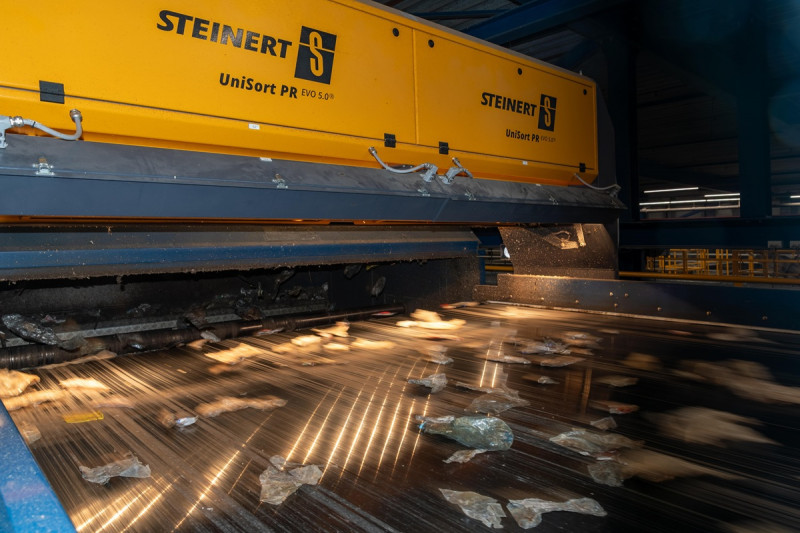 Steinert UniSort PR EVO 5.0 sorts PET trays at Cirrec using sensor fusion and AI according to food-specific quality criteria. - (Image: Steinert) The regulatory requirements only allow the reuse of plastic packaging that has previously been in contact with food. Visually similar but non-food-grade PET applications, such as blister packaging for non-food products, must be reliably excluded. Since these materials can hardly be distinguished chemically, conventional NIR sorting systems reach their limits. Advert Cirrec therefore relies on AI-supported sensor fusion technology from Steinert. Three UniSort PR EVO 5.0 sorting systems are used to analyze every single object. A hyperspectral NIR camera records the chemical properties of the material, while a color camera simultaneously recognizes visual features such as shape, printing, and surface structure. Both sensors record the same material point synchronously, which is intended to enable high data quality for the AI evaluation.
Based on this data, the Steinert Intelligent Object Identifier (IOI) operates as an AI-based sorting program specifically trained to recognize food packaging. The system identifies characteristic features of typical food trays and achieves sorting purities of over 95 percent. This creates the prerequisite for the subsequent processing steps. Following the delivery of the bales, the overall process first involves the separation of ferrous and non-ferrous metals using an overbelt magnet and eddy current separator. This is followed by optical sorting, then grinding, washing, and further processing into flakes and pellets. The recovered recyclate is used within the Faerch Group to manufacture new packaging, which contains an average recycled content of around 70 percent. A life cycle analysis has shown that tray-based rPET causes approximately 57 percent lower CO2 emissions compared to virgin PET. Cirrec currently sees itself as the only operator worldwide recycling post-consumer PET trays into food-grade material on an industrial scale. The project aims to prove that closed-loop tray-to-tray recycling for rigid food packaging is technically feasible, provided the sorting technology achieves the required precision. The AI solution used can be trained flexibly and can be adapted to changing material flows or new packaging designs. More information: steinertglobal.com |
Steinert GmbH, Köln
 back to news list back to news list | back to top |