plasticker-News
Anzeige
| 2026-09-21, 06:00 |

|
Bedeko Targets Recyclate Quality with Additive Portfolio
 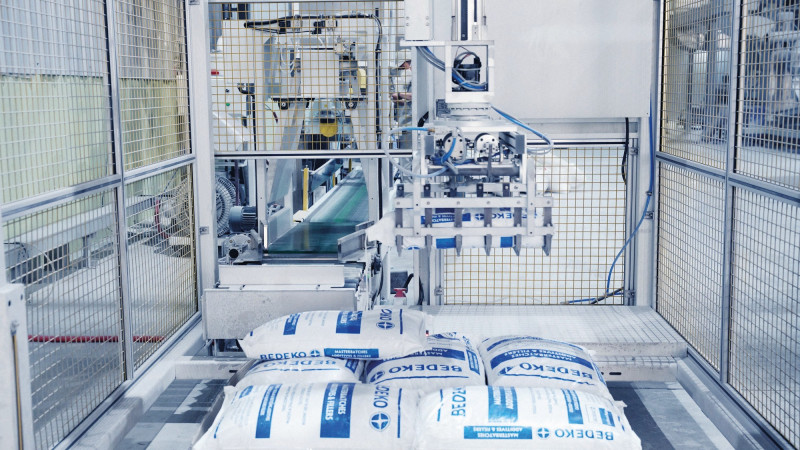 Automated bagging and palletising at Bedeko Europe - (Photo: Bedeko Europe). The Jawczyce, Poland-based company also supplies black, white and coloured masterbatches, calcium-carbonate filler masterbatches, other fillers and conventional modifiers. At Fakuma, however, the focus will be on products intended to improve impact strength, reduce odour, enhance compatibility in mixed polymer streams, adjust melt flow and manage residual moisture. Advert The growing use of recyclates in packaging is increasing the relevance of such materials. Under the EU Packaging and Packaging Waste Regulation (PPWR), Regulation (EU) 2025/40, minimum levels of post-consumer recycled content will apply to certain plastic packaging from 2030 or, in some cases, from a later date linked to implementing legislation. Depending on the type of packaging, the minimum recycled-content requirements are 10, 30 or 35 percent.
For processors, higher recyclate shares can increase the need to compensate for inconsistent feedstock quality and material properties that differ from those of virgin polymers. Improving impact strength Bedeko’s “RX” range is designed to improve the impact performance of PP and PE recyclates. Repeated processing can cause polymer chain degradation, reducing molecular weight and, in many cases, impact strength. Bedeko says its additives can increase impact strength from around 6 kJ/m² to approximately 11–12 kJ/m². The company also claims that the modifiers can help maintain modulus and mechanical performance at temperatures down to -40 °C and reduce internal stresses in thick-walled injection-moulded parts. Potential applications include transport crates, pallets, rigid thick-walled packaging, extruded pipes and household appliances. Tackling odour in recyclates For recyclates with odour problems, Bedeko offers “Odosorb Pro 3”. While washing can remove surface contamination, volatile organic compounds retained in the polymer may be released again during processing. According to Bedeko, the additive reacts with and neutralises odour-causing molecules at processing temperature. The product is intended to target aldehydes, ketones, amines and sulphur compounds and can be used in PE, PP, PS, ABS and PA at dosages of 0.5–2 wt%. Bedeko sees potential applications in household appliances, automotive interiors and consumer packaging where odour is a critical quality parameter. Compatibilisers for mixed waste streams The company’s “RC” range targets mixed and contaminated polymer streams. Incompatible polymers can form multiphase structures with weak interfaces, resulting in poor mechanical performance. Bedeko’s compatibilisers are intended to improve adhesion between these phases and stabilise the compound. For mixed post-consumer streams including PE/PP, PE/PA, PE/EVOH and PP/PET, Bedeko reports Charpy impact strength increasing from about 4–6 kJ/m² to 9–14 kJ/m². The additives are also being positioned for ABS, PC and PS fractions recovered from waste electrical and household appliances, where they are intended to improve compound homogeneity and rheological consistency. According to Bedeko, the products can also be used in waste streams containing residues such as talc, calcium carbonate, glass fibres, pigments, adhesives and label materials. Adjusting melt flow Bedeko’s “Visco” range is designed to modify the melt flow characteristics of PE and PP recyclates. Variations in Melt Flow Index can restrict the use of recycled material when its rheology does not match the requirements of the processing technology. In PE, the additive is intended to increase melt strength and reduce MFI. Bedeko cites a stretch-film recyclate in which the MFI was reduced from around 12 to approximately 2, bringing the material into a range suitable for blown-film processing. In PP, the approach is reversed. Controlled chain scission is used to increase flowability. The company says an MFI of around 8 can be increased to approximately 25 for thin-wall injection moulding, with values of up to about 160 possible for applications requiring very high flow. Managing residual moisture Bedeko also offers “Desicco”, an additive intended for processing recyclates with residual moisture. Moisture can lead to bubbles, surface defects, pressure fluctuations during plasticising and increased scrap rates. The additive is designed to chemically bind water at processing temperatures between 180 and 280 °C. Recommended dosage is 0.5–2 wt%, with applications in PE, PP, PET and PA recyclates and blends. Bedeko says the additive can eliminate the need for four to eight hours of pre-drying. The company estimates that drying-related energy costs can be reduced by 15–25 percent and that production scrap caused by residual moisture can be cut by 60–80 percent. Combined additive packages Bedeko also reports results from applications in which several additives were used together. In one injection-moulding application containing 40 percent recyclate, an impact modifier, compatibiliser and flow modifier were combined. Bedeko says the resulting Charpy impact strength reached 11.8 kJ/m², compared with 12.5 kJ/m² for virgin PP and 6.2 kJ/m² for the untreated recycled blend. The company reports a 22 percent reduction in raw material costs for the application. In a separate blown-film trial, recycled content above 10 percent had previously resulted in unstable bubble formation, film breaks and noticeable odour. After the addition of a flow modifier and odour neutraliser, Bedeko says the recyclate content was increased to 30 percent. Scrap reportedly fell from 6.0 to 2.8 percent, while the finished film was assessed as odour-neutral. Raw material costs were reduced by around 18 percent, according to the company. Production and quality control Bedeko says its additives are manufactured at ISO-certified production sites and supplied with REACH and SVHC compliance documentation. Grades meeting EN 71 requirements are also available for toy applications. The company says its quality-control system includes in-process testing, batch testing by a quality-assurance function independent of production, external testing and certification by SGS, and random follow-up testing of supplied material. Bedeko also operates an in-house laboratory for selecting and adapting modifiers to specific products and processing conditions. According to the company, it maintains more than 8,000 tonnes of safety stock and has production and delivery capacity of more than 15,000 tonnes per month. Fakuma 2026 Friedrichshafen, Germany 12–16 October 2026 Hall B4, Stand 4104 More information: www.bedeko-europe.com |
Bedeko Europe Sp. z o.o. Sp. k., Jawczyce, Poland
 back to news list back to news list | back to top |
Anzeige