plasticker-News
Anzeige

| 2026-10-09, 06:00 |

|
Leistritz: New Feeding Aid Increases Throughput of Polyolefin Fluff Sixfold
 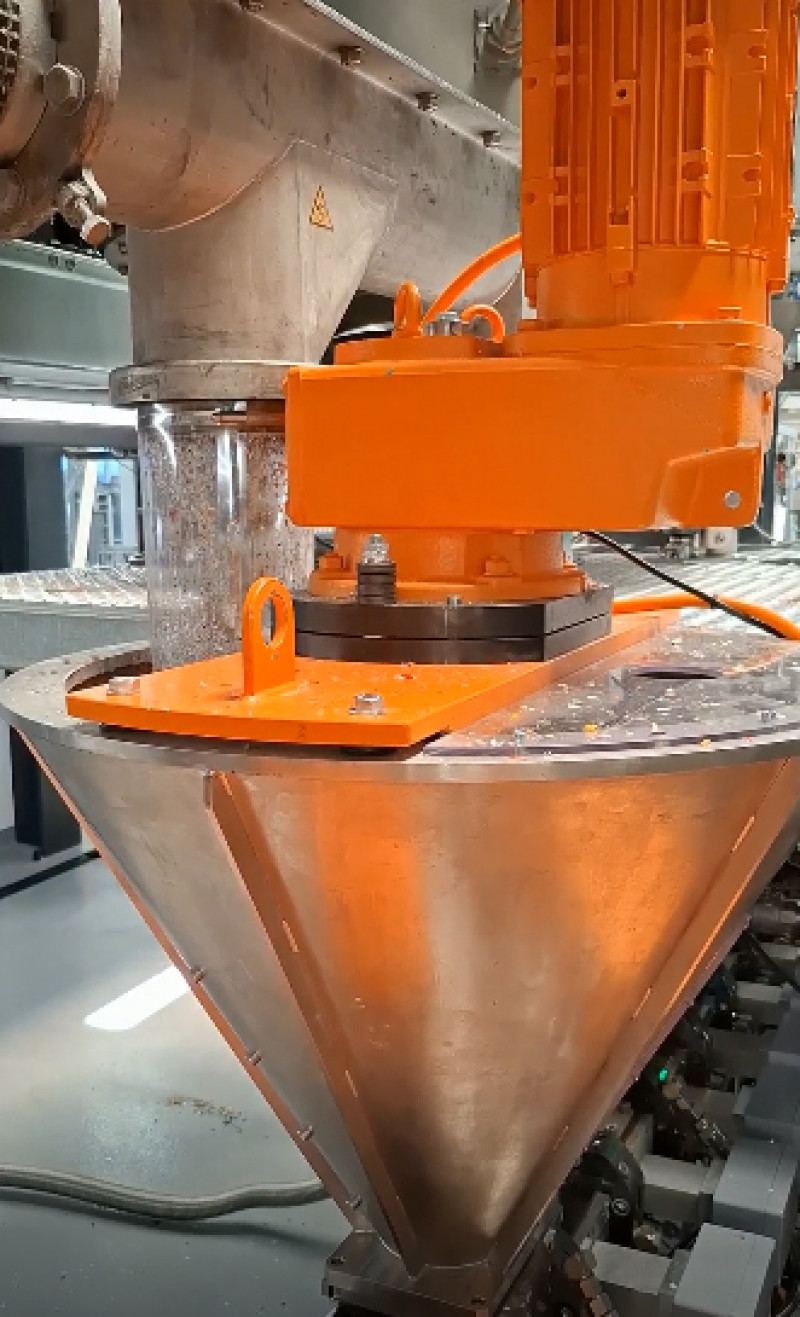 Leistritz Feeding Aid (LEH) – (Photo: Leistritz). When processing materials with low bulk densities, the performance of extrusion systems is often limited by material feeding. Due to their low density and particle geometry, such materials can form bridges in the feed zone or float on top of the extruder screws. This restricts material intake even though the extruder still has available processing capacity. The new feeding aid distributes the material evenly from above onto both extruder screws and breaks up material bridges in the feed zone. The material undergoes only slight compaction. According to the company, this ensures a continuous material flow without exerting additional lateral pressure on the extruder screws. As a result, separate pre-compaction of the feedstock may no longer be necessary. Advert 
Throughput increase with low bulk density materials In a trial on a "ZSE 50 Maxx" twin-screw extruder, Leistritz investigated the processing of polyolefin fluff with a bulk density of 25 g/l and particle sizes ranging from 1 to 5 cm. Without the additional feeding aid, throughput was 40 kg/h. With the "LEH", processing capacity increased to 240 kg/h. This represents a sixfold increase in throughput, equivalent to a 500% improvement. Further trials were conducted with materials having bulk densities of 40 and 75 g/l. For the material with a bulk density of 75 g/l, maximum processing capacity was no longer limited by material feeding but by the extruder's available torque. Specific throughput figures for these two test series were not disclosed. The results demonstrate that material feeding can have a significant impact on the usable capacity of an extruder when processing lightweight bulk materials. Improved feeding allows the available machine capacity to be utilised more effectively, particularly with materials that have a low bulk density. Designed for materials with bulk densities below 100 g/l The feeding aid is designed for materials with bulk densities below 100 g/l. These include lightweight plastic recyclates and other bulky feedstocks whose flow and feeding characteristics make continuous material intake difficult. According to Leistritz, the device can also feed particles whose dimensions exceed the screw channel depth. With conventional feeding systems, such particles can float on top of the screws, impairing material conveying. The feeding aid therefore addresses material intake directly and is intended to enable the processing of low-density feedstocks without upstream compaction. No information is available on the device's energy consumption or its impact on specific processing costs. Presentation at Fakuma 2026 Leistritz has announced that it will demonstrate the feeding aid at Fakuma 2026 on a "ZSE 50 Maxx" twin-screw extruder. The exhibit will be on display in Hall A6 at Stand 6302. Fakuma 2026 Friedrichshafen, Germany 12–16 October 2026 Hall A6, Stand 6302 More information: www.leistritz.com, extruders.leistritz.com |
Leistritz Extrusionstechnik GmbH, Nuremberg, Germany
 back to news list back to news list | back to top |
Anzeige