plasticker-News
Anzeige
| 2026-10-08, 06:00 |

|
Spectrix + voestalpine: Additive Mould Inserts Cut Cycle Time by 28 Percent
 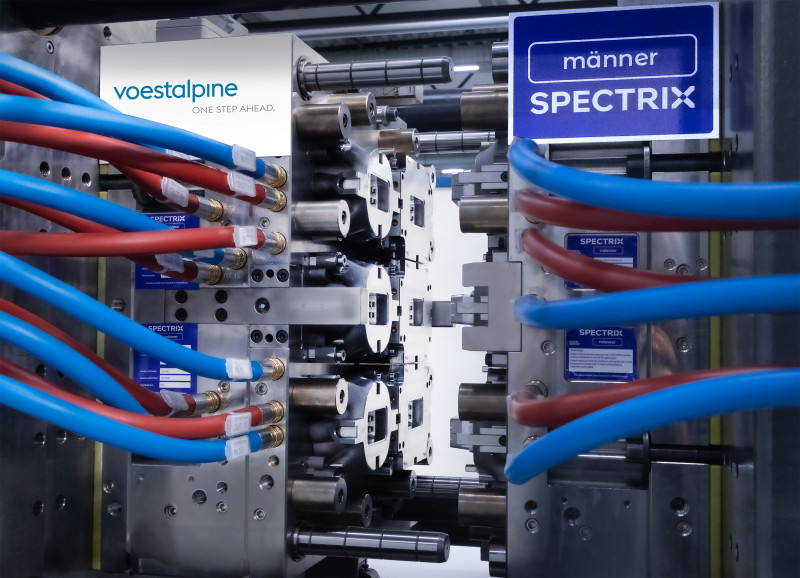 Six-cavity single-face mould with three additively manufactured and three conventionally manufactured mould inserts – (Photo: Spectrix). 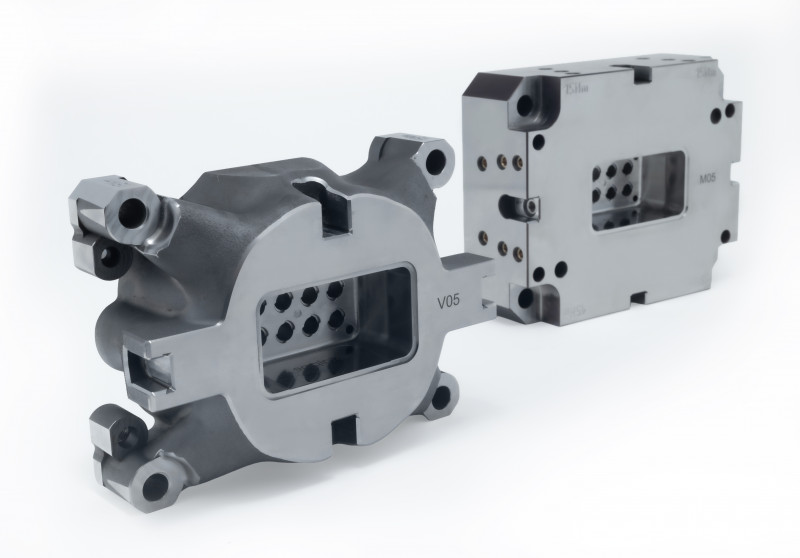 Additively manufactured and conventionally manufactured mould inserts – (Photo: Spectrix). At the heart of the project are additively manufactured mould inserts with conformal temperature-control channels, combined with simulation-based topology optimisation. Unlike approaches in which the geometry of conventional inserts is transferred largely unchanged to 3D printing, the design was adapted specifically to take advantage of the possibilities offered by additive manufacturing. Topology optimisation removes material from areas that are not required either for functionality or to withstand thermal or mechanical loads. Functional areas such as cavity surfaces, sealing surfaces, threaded connections, media connections and mechanical interfaces are retained. In the application investigated, the mass of a pair of inserts was reduced by 27.8 percent without exceeding the specified component tolerances or limit values in the insert parting areas. Advert 
The design takes into account loads arising during both manufacturing and operation, including machining and clamping forces, cavity pressure, thermal stresses, mould clamping forces and demoulding forces. The simulation incorporated safety factors for different load cases. The objective was not to achieve the greatest possible weight reduction, but to find an appropriate balance between material efficiency, stiffness, fatigue strength and manufacturability. 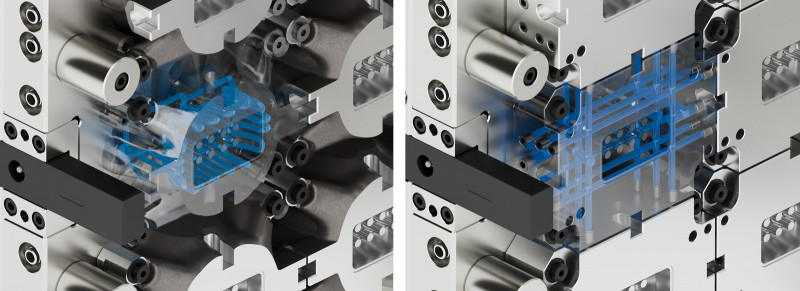 Cooling channels in the conventionally manufactured mould insert compared with those in the additively manufactured mould insert – (Photo: Spectrix). A key technical feature is the conformal temperature control of the additively manufactured inserts. Whereas conventionally drilled cooling channels can only be aligned with the component geometry to a limited extent, additively manufactured channels can be routed much closer to the cavity contour. The temperature-control system was designed using injection moulding simulations to reduce temperature differences across the mould surface and minimise thermal hot spots. According to the project partners, the cycle time in the application shown was reduced from 9.85 to 7.05 seconds, corresponding to a reduction of 28 percent. Residual cooling time was cut by 50 percent. The thermal and mechanical boundary conditions obtained from the simulation also served as the basis for the topology optimisation. 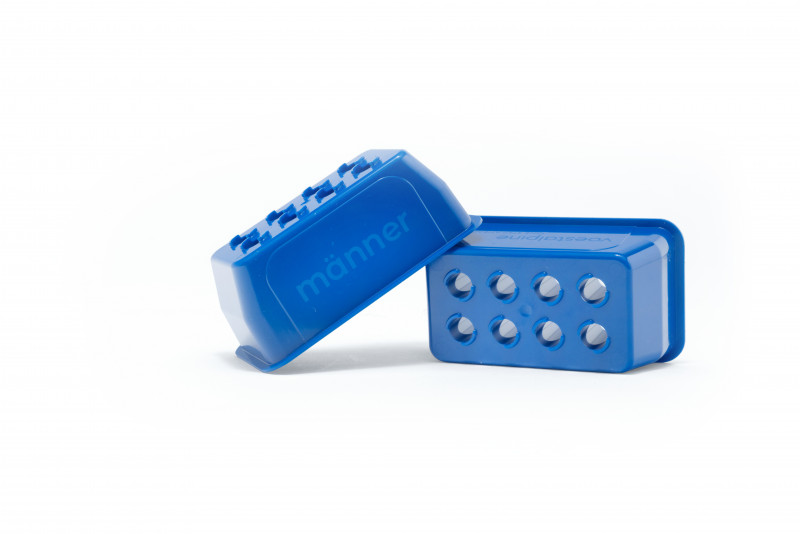 Pipette tip rack – (Photo: Spectrix). The cavities themselves continue to be produced using established precision mouldmaking processes. Milling, EDM and polishing ensure dimensional accuracy and the required surface quality. However, instead of starting with a fully machined block finished on all six sides, the process begins with an additively manufactured, hardened semi-finished part incorporating a machining allowance. Areas of the topology-optimised insert that are not functionally relevant can remain unmachined. Mechanical post-processing can therefore be concentrated on the functional surfaces. The approach combines Laser Powder Bed Fusion (LPBF) for producing the inserts with conventional hard machining for the precision-critical areas. “Uddeholm Tyrax” is used as the material both in a conventionally processed version and in a grade developed for additive manufacturing. The corrosion- and wear-resistant tool-steel powders are intended particularly for applications in which, alongside temperature-control performance, there are also requirements for wear resistance, corrosion resistance and high-gloss polishability. Scaling Benefits at Higher Cavity Counts The concept becomes particularly relevant from an economic perspective in multi-cavity moulds. Reducing the mass lowers the volume of material that has to be built, while potentially shortening build times and improving utilisation of the available build space. The development work involved in design, simulation and optimisation is largely carried out only once and can then be transferred to identical cavities. As the number of cavities increases, this development effort is spread across a larger number of inserts, while the material and manufacturing savings per insert remain. The mould is equipped with the “Männer Performance Line” valve-gate hot-runner system. Temperature control is provided by a “Gammaflux G25”. Production takes place on an “Arburg 570 H 2000-800 Ultimate” injection moulding machine, using “Ineos Styrolution PS 124N” as the moulding material. The component weighs 11.2 g and measures 78.1 x 43.3 x 31.4 mm. The stated printing time for one additively manufactured mould insert is approximately 30 hours. Technical and Economic Assessment Depends on the Application The project demonstrates that the choice between conventionally and additively manufactured mould inserts must be based on the requirements of the individual application. Conventional inserts may remain more economical for less demanding temperature-control tasks or applications with lower levels of complexity. Additively manufactured inserts offer particular potential where short cycle times, uniform mould temperatures, high process stability and high shot counts are required. Additional topology optimisation is intended to improve the economic viability of additive inserts by reducing material volume, printing time and mechanical post-processing. As a result, conformal temperature control may become economically viable even at lower production volumes than would be the case with geometrically unchanged, additively manufactured copies of conventional inserts. Demonstration at Fakuma 2026 Spectrix and voestalpine High Performance Metals will present the six-cavity mould at Fakuma 2026 at the Spectrix stand in Hall A1, Stand 1208. The demonstration mould contains three additively manufactured and three conventionally manufactured mould inserts, allowing the two concepts to be compared directly under identical process conditions. The project partners plan to present further comparative data and the recommendations derived from it in a technical webinar following the trade fair. Spectrix is a strategic business unit and is legally represented by Otto Männer GmbH, Bahlingen am Kaiserstuhl, Germany. Fakuma 2026 Friedrichshafen, Germany 12–16 October 2026 Hall A1, Stand 1208 More information: |
Spectrix - Otto Männer GmbH, Bahlingen am Kaiserstuhl, Germany + voestalpine High Performance Metals GmbH, Vienna, Austria
 back to news list back to news list | back to top |
Anzeige