plasticker-News
Anzeige
| 2026-10-09, 06:00 |

|
Spectrix: Seven-Stage Process Chain for Injection Molding Projects
 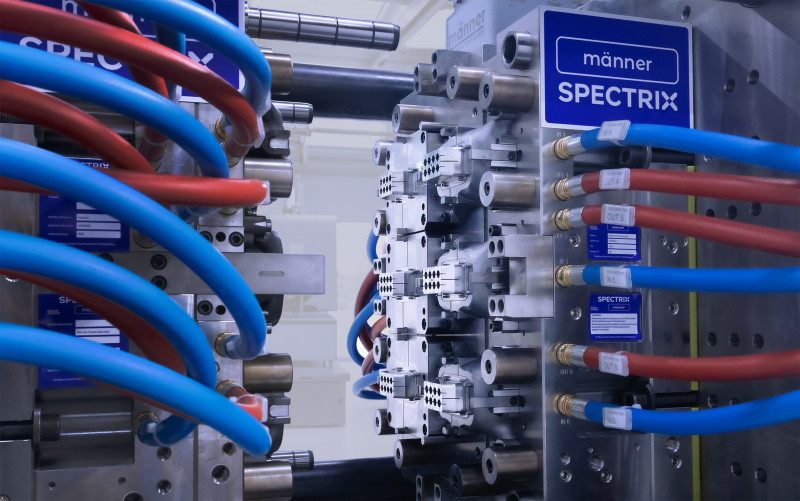 Spectrix End-to-End Injection Molding live at Fakuma 2026 – (Photo: Spectrix). At the center of the exhibit is a six-cavity single-face mold for a pipette tip rack, running live as part of a complete production cell during the trade fair. Advert Spectrix structures its approach around seven stages: early project involvement, product development, piloting and prototyping, production mold manufacturing, validation and integration, production and scaling, and lifecycle support. A key focus is the coordinated development of the molded part, material, mold, hot runner, temperature control, automation, and injection molding process.
Early Involvement and Product Development Spectrix aims to align material selection, part geometry, and the manufacturing concept with future series-production requirements at an early stage, before mold construction begins. The group combines co-development and Design for Manufacturing with material and process expertise. According to Spectrix, more than 500 polymer grades have been tested and documented. The group has more than 150 mold and hot-runner designers as well as over 30 application and mold-flow engineers supporting design, simulation, and process development. Simulation tools are used to assess factors such as filling behavior, thermal conditions, and potential process risks before the production mold is built. Production Mold and Hot-Runner Technology Where required, pilot molds and pre-series production can be used to validate new tooling or process concepts before industrialization. For the Fakuma demonstrator, however, Spectrix skipped this intermediate stage due to the relatively straightforward six-cavity layout and moved directly to a production mold. The six-cavity single-face mold was built by Männer. Its 3D-printed cavities are subsequently precision-finished using conventional machining processes including milling, EDM, and polishing. Melt distribution is handled by a naturally balanced six-cavity hot-runner system from the Männer Performance Line. Temperature control is provided by the Gammaflux G25. According to the company, the system measures temperature 20 times per second and controls it with a stated accuracy of 0.017 °C. The objective is to maintain uniform thermal conditions throughout the hot-runner system and across all cavities. Validation and Production Cell Integration Once the mold is complete, Spectrix coordinates the mold, injection molding machine, and automation as an integrated production system. The company applies a Scientific Molding approach in which key process parameters are systematically identified and a robust processing window is established. Depending on the application, support can also include functional verification, process validation, and the DQ, IQ, OQ, and PQ qualification stages. For regulated applications, this may extend to transfer into the production environment and a Site Acceptance Test. For the Fakuma demonstration, the mold will run on an Arburg 570 H 2000-800 injection molding machine. Production, Scaling, and Lifecycle Support Spectrix says its technology centers worldwide are equipped with more than 60 injection molding machines for trials, sampling, validation, and production ramp-up. Through its Specialty Injection Molding activities, the group can also provide bridge and temporary production. This can be used, for example, to cover the period before full-scale series production begins or to support the controlled transfer of a process to a later production site. The service portfolio also includes low-volume production and specialized niche manufacturing. For selected applications, Spectrix can additionally provide permanent series production. According to the company, these manufacturing activities are supported by documented quality processes and traceability. After series production has started, lifecycle support covers maintenance, spare parts, optimization, refurbishment, and modernization of mold and hot-runner systems. The aim is to provide technical support throughout the operating life of the production equipment, rather than ending support after initial ramp-up. Integrated Expertise Across the Spectrix Group Spectrix brings together the brands Männer, Foboha, Synventive, Thermoplay, Gammaflux, and Priamus. The combined portfolio spans co-development, mold and hot-runner engineering, sensing and process control, system validation, specialty injection molding, and lifecycle services. According to Spectrix, the group employs around 2,000 specialists worldwide and operates eight production sites as well as more than 60 sales and service locations. The Fakuma application is intended to demonstrate this end-to-end process chain using a specific medical technology component under real production conditions. The production cell will run live at the Spectrix booth in Hall A1, Booth 1208. Fakuma 2026 Friedrichshafen, Germany October 12–16, 2026 Hall A1, Booth 1208 More information: |
Spectrix - Otto Männer GmbH, Bahlingen am Kaiserstuhl, Germany
 back to news list back to news list | back to top |
Anzeige